
Still plenty of time to enter Omega Channel's Masters of Horror DVD giveaway. Click here for details.
Thursday, April 20, 2006


Hostel
 "You're so serious, Mr. Serious American."
There needs to be a name for this new sub-genre of non-supernatural torture and murder films to which Wolf Creek, Hostel, Saw and their ilk belong. I've been calling them "bolt cutter movies" because of a particular cringe inducing scene in Hostel. I'm just going to throw this out there and see if people pick up on it. Anyone? Yeah, I know. It's like trying to give yourself a nickname.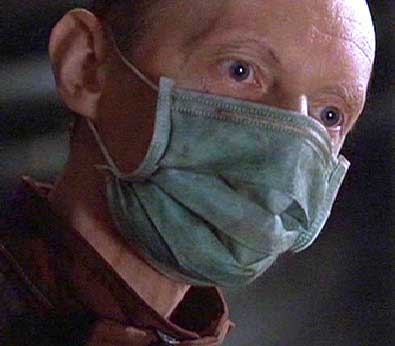 Pax and Josh, two young Americans are backpacking through Europe with their Icelandic buddy Oli. During a stay in Amsterdam the three partake of the hash bars and legal prostitution, but as Josh says, "there are too many Americans around." They meet a fellow named Alexi who tells them of a hostel in Slovakia where the women are beautiful and sex-starved. "They hear your accent and they want to f**k you," he says. Guided by their hormones, the three travelers leave for Slovakia in search of hedonistic excess. They find Alexi's hostel and it is everything he promised. The accommodations are suspiciously high-scale and the women are both beautiful and frequently naked.
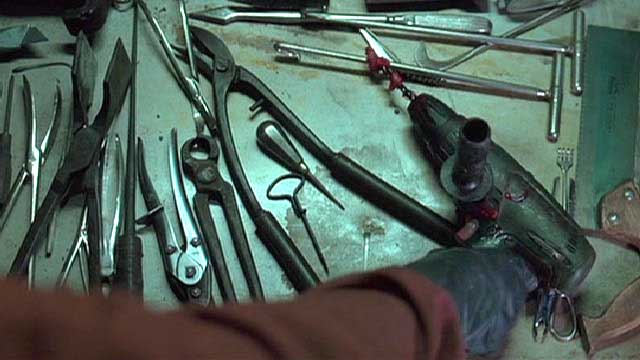 Things take a dark turn when Oli disappears. Pax receives a text message saying simply "I go home." Josh and Pax don't buy it, though. After a second night of partying with the girls from the hostel, Josh finds himself handcuffed to a chair in a dark room. He is not alone, and the array of pliers and power tools set up on a nearby table serve to assure that Josh is about to have a bad day.
Eli Roth's previous film Cabin Fever mixed the humor with the horror to reasonably good effect. With Hostel he takes a much darker approach, and once we are in the thick of the story there isn't a grin to be had. This is the Unrated Director's Cut, though I can't say I noticed any differences from the theatrical version. I had seen Hostel during it's theatrical run, but I decided to give it a second look on disk and I'm glad I did. My initial viewing had been marred by a director with loose lips. I had listened to an interview with Roth on Rue Morgue Radio and in his zeal to promote the movie he gave away too much, ruining the film's biggest surprise. Of course, there were no surprises during the second viewing, but then I wasn't expecting to be surprised (again with the oxymorons here) and was better able to appreciate the film. The director does an excellent job of creating a sense of alienation, and of showing how far from home these American students are. Isolation is a key element of horror, and Roth achieves this nicely. I'm reluctant to give too much away, but suffice it to say, once things get rolling even the heartiest of horror fans will have something to squirm about. This is not a masterpiece--the early part of the film feels like Porky's Goes to Amsterdam--but it accomplishes what it sets out to do.
Wednesday, April 19, 2006
Upcoming Releases Worth Noting
Here are a few upcoming releases that have caught my attention: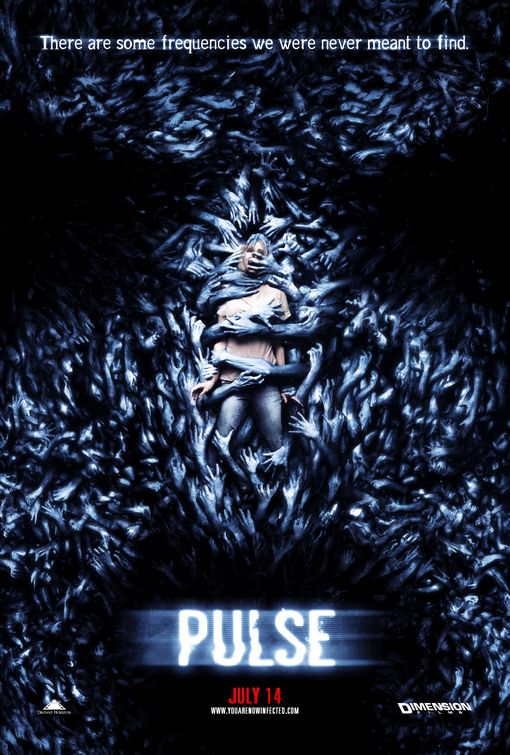 Pulse (2006)
This is the latest in the wave of U.S. remakes of Japanese horror films. I recently saw the original 2001 version--known in Japan as Kairo--which frankly left me cold. My full review will be appearing in the summer issue of Phantom of the Movies Videoscope, but in a nutshell there are some good moments surrounded by more moments of tedium, and the story is just plain murky (my oxymoron for the day). The story involves a series of suicides that may or may not (like I said: murky) have something to do with the spirits of the dead returning via the internet.
Despite this, I have cautiously high hopes for the remake. The poster (click on the thumbnail for a closer view) is the stuff that nightmares are made of. The trailer is included on the Wolf Creek DVD, and there are some intriguing bits. What was implied in the Japanese original seems far more upfront here, and I'm hoping that kind of clarity will help. Oddly enough, the trailer contains scenes from the Japanese original. Whether or not these scenes are also in the final film remains to be seen. Kristen Bell, star of TV's Veronica Mars, is an interesting choice for the lead as well. If you don't have the Wolf Creek disk handy you can link to the Pulse trailer at the IMDB.
The U.S. theatrical release date is July 14, 2006.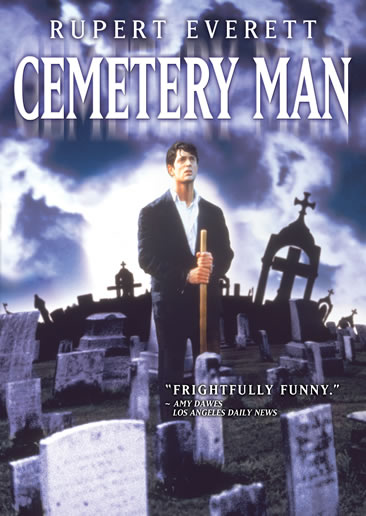 Cemetery Man (a.k.a. Dellamorte Dellamore, 1994)
This late entry in the Italian zombie movie sweepstakes finally makes its DVD debut on June 16, 2006. Directed by Michele Soavi--yes, the guy who watched his girlfriend vomit her own intestines in Lucio Fulci's City of the Living Dead/The Gates of Hell--Cemetery Man is the swan song of Italian zombie movies, but it also rises above the genre to become something else entirely. Rupert Everett plays a cemetery watchman whose job is not to keep people out, but to keep the graveyard's occupants in. The film has great horror elements, but can also be funny and touching.
You can get the full specs on the disk at Anchor Bay Entertainment's website. Equinox (1970)
This no budget chiller has been a favorite of mine for years. I've seen it on television, VHS, and a grainy bootleg DVD, and now it makes its official DVD bow thanks to the prestigious Criterion Collection. Begun as a student project with some highly ambitious stop-motion animation, Equinox was shot over the course of several years. The story involves four friends who encounter a variety of monsters in the woods that have been conjured by an ancient and evil book of spells. Much has been made of the resemblance between this film and The Evil Dead, though personally I think the similarity is superficial. Frank Bonner is one of the stars, years before he played Herb Tarlek, General Sales Manager of WKRP in Cincinnati, a sitcom that just screams for a DVD release of its own.
Equinox hits stores on June 20, 2006.
Tuesday, April 18, 2006
Masters of Horror DVD Giveaway
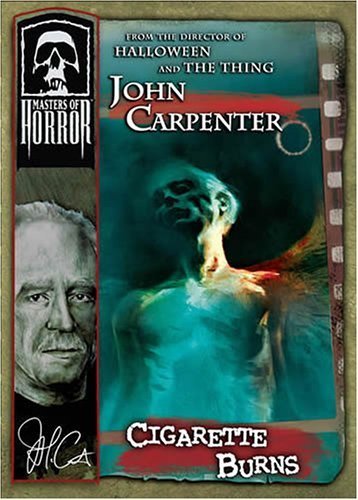 The good folks at Anchor Bay Entertainment have provided Omega Channel with a copy of John Carpenter's Cigarette Burns, the first DVD release from the Showtime Masters of Horror series. Some lucky blog-surfer is going to walk away with this way cool disk, previously reviewed on this site. In addition to the feature the disk includes:
- Commentary by director John Carpenter
- Commentary by writers Drew McWeeny & Scott Swan
- "Celluloid Apocalypse: An Interview with John Carpenter" featurette
- “Behind The Scenes: The Making of Cigarette Burns" featurette
- "Working With a Master: John Carpenter" featurette on the director and his work
- "On Set: An Interview with Norman Reedus" featurette
- John Carpenter Bio
- Still Gallery
- Trailers
- DVD-ROM: Original Screenplay and screen saver
All you need to do is send an email to omegachannel.matt@gmail.com with the subject header “ John Carpenter's Cigarette Burns DVD giveaway,” stating your name in the body of the email and asserting that you are over 18 years of age. All entries must be received before midnight Eastern time on Wednesday 5/3/06. After that a winner will be chosen at random and notified within three business days. Void where prohibited by local law. Contest open only to residents of the continental United States and Canada. No purchase necessary (especially since I'm not selling anything). One entry per email address. Duplicate entries will be deleted. All decisions made by the management of this blog in regard to this giveaway are final.
Good luck to all.
Monday, April 17, 2006
Master's of Horror:
Stuart Gordon's Dreams in the Witch House
 “She has come. Your soul is in peril.”
This second installment in Showtime's Masters of Horror series features an adaptation of a short story by H.P. Lovecraft. Stuart Gordon has made a career for himself adapting the works of H.P. Lovecraft to the screen. Quite a feat considering that many of Lovecraft's stories are virtually unfilmable. Gordon has a knack for finding the workable elements in Lovecraft's stories, making these films seem more like collaborations than adaptations. Re-animator and From Beyond may not be pure Lovecraft, but they are pretty wild rides in their own right. I was concerned when I saw that Ezra Godden was starring in this episode. It was Godden's performance that, in my mind, sabotaged Gordon's previous Lovecraft adaptation Dagon. It seemed obvious that he had been cast for his physical resemblance to Jeffrey Combs, star of From Beyond and the Re-animator films, and Godden's character required a range he seemed incapable of displaying. This was unfortunate, since Dagon had some of purest Lovecraftian moments of any of Gordon's adaptations, but the film as a whole didn't work.
 In Dreams in the Witch House, Godden plays Walter Gilman, a grad student at (where else?) Miskatonic University. He's working on his thesis in String Theory and he needs a cheap, quiet place to study. He finds just that in a run down, vermin-infested, 300 year old boarding house. His neighbors include a seemingly crazy old man who chants loudly and beats his head against a table top at all hours of the night, and a single mom named Frankie. Both Frankie and her baby son Danny take a shine to Walter after the young student chases a rat from their room.
There are some strange anomalies in the boarding house's construction. The corners of Walter's room intersect in a bizarre manner very much resembling the intersecting plains of a String Theory diagram on his laptop. There seems to be a link between these strangely connected walls and the witch that begins appearing in Walter's dreams—if in fact they are dreams. The witch seduces Walter in these visions and compels him to commit horrific acts. It seems she and her companion—a rat with a human face—need a baby for a sacrifice, and she has her eye on little Danny next door.
Gordon doesn't quite hit this one out of the park like Carpenter did with Cigarette Burns. While not exactly predictable, the story does follow a fairly linear path, and anyone familiar with Lovecraft's work knows not to expect a happy ending. Gordon does capture the Lovecraft spirit, though, and the presence of The Necronomicon, rat-infested walls, and bizarre architecture (reminiscent of the oft-sited “cyclopean temples”) are hearteningly familiar. Godden redeems himself nicely with this film. He manages the transformation from a studious nerd to a terrorized and tortured soul with believability, and the absence of horn-rimmed glasses makes his resemblance to Reanimator character Herbert West far less noticeable. As with John Carpenter's Cigarette Burns, the one hour format works to the story's adavantage, allowing for a pace that more closely resembles that of a short story. The witch manages to be both sinister and seductive, and the man-faced rat, though not always convincing, still gets points for character.
Sunday, April 16, 2006
The Great Basil Wolverton/Tales From the Tomb Controversy
OK, not exactly a controversy. More of an anomaly really—if that even—but an interesting one. As I mentioned in an earlier post, a certain comic book called Tales From the Tomb from Eerie Publications messed with my head at an early age. Meat cleaver massacres, gallons of blood, dangling eyeballs. It's a wonder I can function in society at all.
By the 1970's, The Comics Code Authority established in the 1950's had effectively severed the Achilles tendon of horror in the comics medium. Restrictions were so tight that horror wasn't viable in the standard comic book format (despite tepid attempts like DC's House of Mystery, House of Secrets, etc.). Several publishers, including Eerie Publications, got around this by printing their books in a magazine-sized black and white format, thus skirting the Comics Code Authority entirely.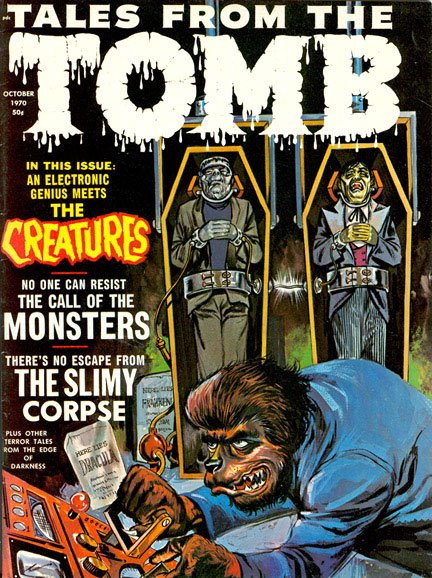 The mag in question was the October 1970 issue (henceforth referred to as Exhibit A. Well... no, not really) which you can see to your left. I was fascinated and I read that comic until it literally fell apart. Even years after that pulp paper atrocity had disintegrated, the stories stuck in my head like a bug in a roach motel. I read a lot of comics after that one, but I'll tell you, after seeing the eyeballs fly in an Eerie Publication, Archie's indecision as to whether he should take Veronica to the sock hop or study with Betty just doesn't cut it as compelling fiction.
 Then in June of 1986 came issue #5 of Death Rattle (Exhibit B, to your right) from Kitchen Sink Comix. Death Rattle, though no longer in circulation, remains one of my favorite horror comics of all time. The art and writing were well above average and they would even occasionally reprint a classic story form the Golden Age. That particular issue carried a reprint of a story called "Robot Woman," the tale of a robotics genius with social issues who decides to build himself the perfect woman with Twilight Zone-ian mixed results. The story was drawn by one of the true greats of 1950's horror and science fiction comics, Basil Wolverton. [Incidentally, one of Wolverton's best loved stories was "The Brain-Bats of Venus." The Brain-Bat you see over in the far right column of this blog is my homage/reinterpretation.]
The odd thing was that I had seen this story before, though in a different form. I distinctly remembered a story called "Until Death do us Part" in that long gone issue of Tales From the Tomb. I could tell that the art was different, but the story was virtually the same right down to the panel breakdowns. It was like seeing that old comic again as it had been published in some parallel dimension.
It seems that much of Eerie Publications' content at the time was derived from pre-code horror comics. It was common practice for them to alter the artwork from those stories to add large helpings of gore. In this case, the entire story was redrawn, and the dialogue slightly altered. I suppose it's possible that Wolverton's style—striking though it is—seemed a bit dated by 1970. There are several other stories in that same issue of Tales From the Tomb that are clearly drawn in a 1950's style. Perhaps the idea was to get a stronger legal hold on the material. It's possible that "Robot Woman" and much of this other material was in public domain by this time, so creating new artwork might shore up any copyright issues.
This is all conjecture, though. My real reason for this posting is to show the two stories side by side. I've seen writings about Eerie's practice of redrawing stories, but I've never seen any reference to this specific case. Each of the scans below contains a page from the original Wolverton "Robot Woman" story along with the corresponding page from Eerie Publications' "Until Death Do Us Part" (which I reacquired thanks to Ebay).
Please note that, to the best of my knowledge, both of these stories are in the public domain.
Click on thumbnails for a larger image.
PAGE 1 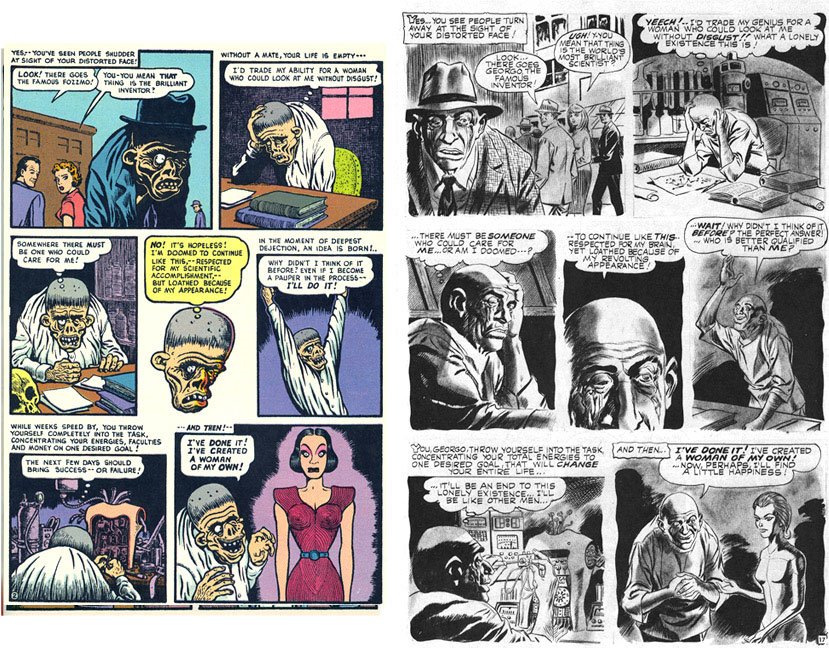
PAGE 2 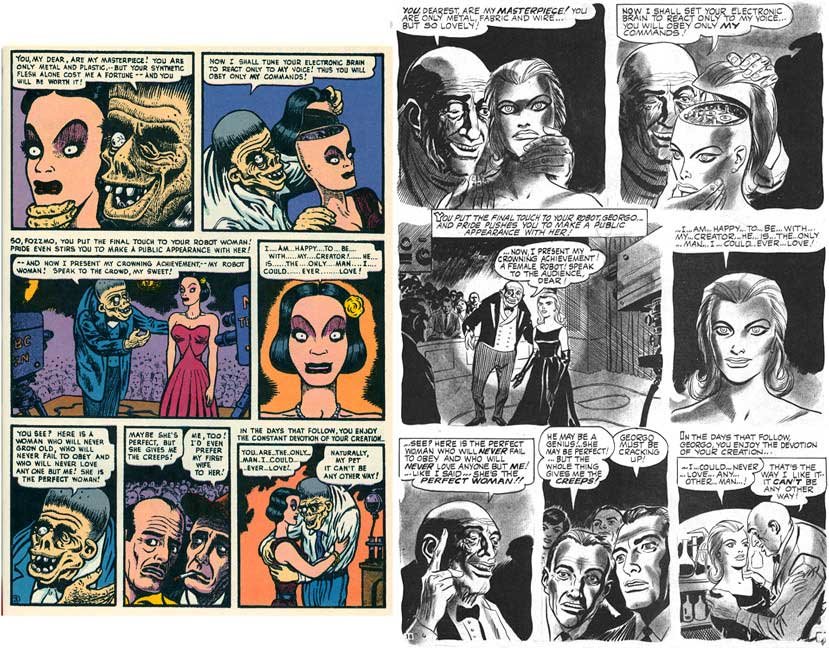
PAGE 3 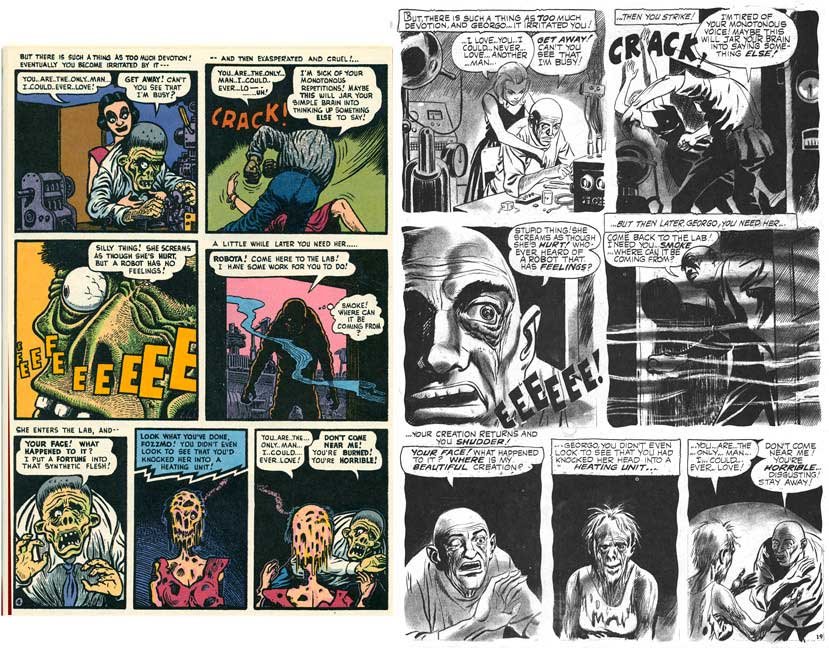
PAGE 4 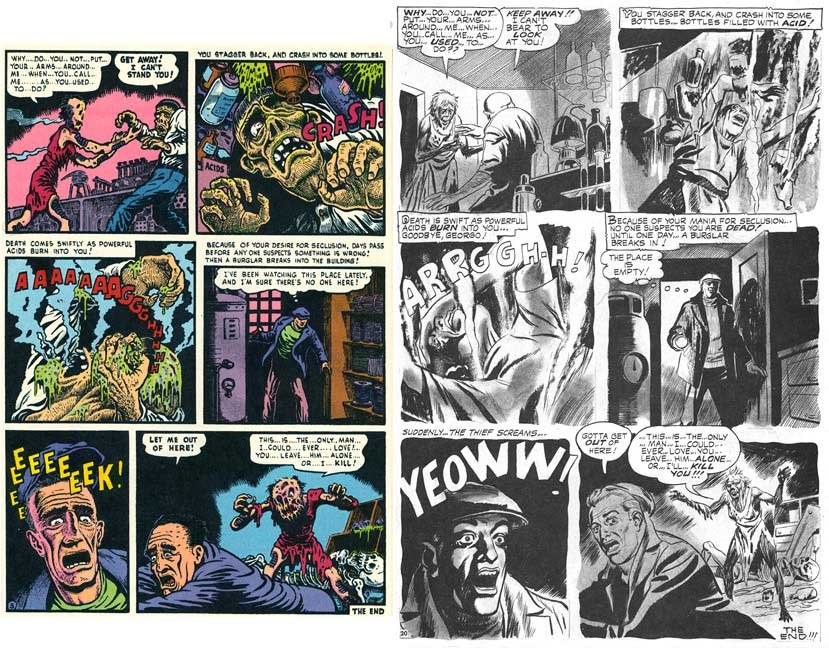
PAGE 5
Well, I'm glad I finally got that off my chest.

Friday, April 14, 2006
Return of the Living Dead
 “They're back from the grave and ready to party.”
Since Return of the Living Dead 4: Necropolis arrives on DVD next week, now seems like a good time take a look back at the movie that started the franchise.
After the completion of Night of the Living Dead, director George A. Romero and screenwriter John Russo both came away from the project with sequel rights. Romero of course went on to make Dawn of the Dead (hailed by many as one of the greatest horror films of all time) and Day of the Dead (a flawed effort, but still worth a peek). Russo made his sequel initially in the form of a novel called Return of the Living Dead. Russo wrote several B grade horror novels of widely varying quality throughout the 70’s and 80’s. Eventually the film rights ended up in the hands of writer/director Dan O’Bannon. Feeling Russo’s script was too similar to what Romero had done with Dawn of the Dead, O’Bannon wrote his own script, which took a more light-hearted approach to flesh-eating dead folks. Interestingly, story credit is still given to Russo, Russell Streiner (best known as Johnny from Night of the Living Dead), and Rudy Ricci (another Romero mainstay who, among other things, played a biker in Dawn of the Dead). I can’t say what Russo and company’s screenplay may have been like, but the final film bears no resemblance whatsoever to Russo’s snore-fest of a novel.
The film opens at the Uneeda Medical Supply warehouse. Frank (James Karen) is showing new employee Freddie (Thom Matthews) the ropes. During the tour of the facility Frank reveals that Night of the Living Dead was loosely based on true events. It seems the army created a nerve gas that, as an added bonus, could revive the dead. Due to an army snafu, several canisters of once reactivated dead folks packed in their own tangy reanimating juices were delivered to the warehouse and have been collecting dust in the basement. One of the canisters ruptures, giving Frank and Freddie a face full of reanimation gas and allowing the chemical to escape into the ventilation system, reviving a corpse in the warehouse freezer. Burt the warehouse owner (Gulager) arrives and decides the best way to dispose of the walking dead guy is to drive a pickaxe through his head. Good try, but we quickly learn these aren’t your father’s walking dead. Destroying the brain doesn’t work like it did in Night of the Living Dead (“You mean the movie lied?” asks an anguished Freddie).
Burt decides to hack up the zombie, cart it to the crematorium conveniently located across the street, and no one will be the wiser. Again, good try, but the smoke from the burning zombie seeds the clouds overhead with the reanimation chemical. A convenient rainstorm spreads the chemical over an equally convenient cemetery, where conveniently enough Freddie’s punk friends are waiting for him to get off work.
All this proves to be pretty damn inconvenient for the living members of the cast. Soon dead folks are clawing their way out of the ground and they’re pretty damn hungry. Unlike the undiscriminating zombies of Romero’s films who would gorge themselves on any old hunk of warm flesh, these guys are after brains and brains alone. After all, these are the kinder gentler walking dead of the Reagan Era.
Horror and comedy make for a difficult mix. Usually they go together as well as ice cream and mayonnaise, the humor diluting the horror and vice versa. Return of the Living Dead is a fun little bit of fluff, but at no point does the film work perfectly. While some of the main zombies like Tarman, the half-zombie, and Linnea Quigley’s nude zombie are eye-catchers, most of the background zombies are unimpressive, often looking like no more than people covered in mud. The first zombie who comes out of the ground, in what should be one of the pivotal moments of the film, is laughably cheap looking. The pluses ultimately outweigh the minuses, however. The aforementioned Tarman is a creepy, gooey example of pre-digital effects. The story moves at a good clip, thanks to a strong cast, particularly James Karen and Clu Gulager. The eighties punk soundtrack is excellent and available on CD. The gang of punk kids is cartoonishly entertaining, and Linnea Quigley is naked throughout much of the movie. It could be worse, friends. It could be much worse.
Wednesday, April 12, 2006
Wolf Creek
 “30,000 people are reported missing in Australia every year. 90% are found within a month. Some are never found again.”
It's good to know that some things are universal, cutting across cultural lines to help bring us all together. If nothing else, Wolf Creek proves there IS Spring Break in Australia. Two British college girls Liz and Kristy, along with their Aussie friend Ben, have just finished up a glorious stay on the Australian coast. They've gotten a good price on a used car (yeah, foreshadow this!) and they're bound for Wolf Creek Crater, a real life meteor crater, 875 meters in diameter, believed to have been formed when one big-ass space rock touched down during the Pleistocene Era. The vacation starts to go south when Ben's car refuses to start, leaving the trio stranded in the middle of a vast Australian nowhere. Just as they prepare to spend the night in the car, a seemingly friendly local named Mick Taylor arrives and offers to tow their car back to his camp for repair. There is some trepidation, but Mick seems like an amiable enough cuss. He sets to work fixing the car while the stranded young folk drink the fresh water Mick has offered.
Liz wakes up sometime later. She's alone, bound and gagged on the floor of a shack. The water, it seems, was drugged. Fighting off hysteria, Liz manages to free herself, and following the sounds of Kristy's screams, she finds her friend bound and bloody at the mercy of their host Mick, who is the antithesis of the good samaritan they originally believed him to be. Ben is nowhere to be seen, and Liz is forced to make some of the toughest decisions of her life.
Some might say it takes awhile for the action to kick in, but I say that is time well spent. These are not the cookie-cutter teens of so many other horror movies. The extended character development is essential, letting us know who these kids are and making what eventually happens to them all the more horrifying. And make no mistake, what happens IS horrifying. What with the camping, the presence of a video camera, and the ever building tension, Wolf Creek at times feels like The Blair Witch Project with the gender ratio reversed. The similarity may not be a coincidence. The Blair Witch Project was a work of fiction disguised as a documentary. Wolf Creek is allegedly “inspired by true events,” so both films attempt to more closely engage the audience by implying that what we are seeing is real. Reinforcing this is the fact that the characters do not make a lot of the usual horror movie mistakes (“Let's split up and die!”). Also, as with Blair Witch, we are given a cast of unknowns, actors who come to us with absolutely no preconceived notions, adding immensely to the realism. The fact that much of Wolf Creek is obviously based on conjecture and not established facts is irrelevant, and does not diminish its impact.
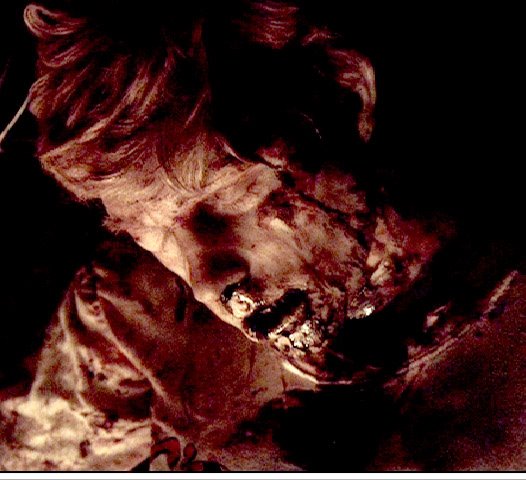 It's interesting to note that slasher movies like the Friday the 13th and Halloween movies—as well as their countless imitators—attempted to up the horror by putting a mask on the killer. The faceless killer was meant to stimulate a fear of the unknown. Wolf Creek does a full turnaround, giving its killer a human countenance, showing us that an inhuman monster in a Halloween mask isn't nearly as frightening as a real person who just enjoys hurting people because he's wired that way.
Tuesday, April 11, 2006
Masters of Horror:
John Carpenter's Cigarette Burns
 “Something happens when you point the camera at something terrible. The resulting film takes on power”
Since the Masters of Horror series debuted on Showtime awhile back, there’s been much written about the series both online and off. I've avoided reading that stuff until recently. The show looked promising, offering a stand alone horror film by a maestro of the genre in every episode. Not being a Showtime subscriber I didn't want to torture myself reading about a potentially great series of films I wasn’t going to be able to see until the DVD release.
Since only two episodes have made it to DVD so far, I certainly can't judge the series as a whole, but I am pleased to say John Carpenter's Cigarette Burns was worth the wait. It's a taut thriller with underlying themes of obsession and the inability to let go, and as a film buff I can certainly get behind its central idea: the quest for a lost film. Kirby Sweetman (Norman Reedus), a mildly disheveled filmophile with a perpetually rumpled suit, is hired by a Mr. Ballinger (Udo Kier) to track down the Holy Grail of lost films: La Fin Absolue du Monde (The Absolute End of the World), a 1971 film whose only showing caused a fearsome outbreak of violence. As a result the film was banned and its only print destroyed. Since that time the film has been shrouded in mystery, but Ballinger insists the film does still exist. Ballinger is a film connoisseur, and he owns a most unusual souvenir from the production: an angel whose wings were severed on camera. As the angel explains, he is bound to the film on the deepest of levels. Were the film to be destroyed, he would know.
Ballinger offers Kirby $200,000, a sum Kirby needs badly to pay off the debts on his theatre, a "shitbox" as Ballinger calls it that Kirby uses to show eclectic films. The lien holder is Kirby's father-in-law, a relationship made all the more tense by the fact that Kirby's heroin addicted wife committed suicide.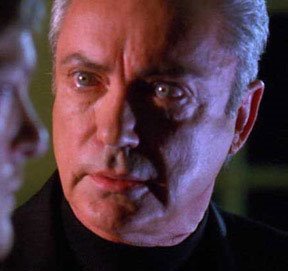 Kirby's search for La Fin Absolue du Monde takes him down increasingly bizarre paths. Everyone who has had any kind of contact with the film has been effected by it. A.K. Meyers, the only critic to have reviewed the film, has spent the intervening years writing a new review, one that literally fills an entire room. Henri Cotillard, a film archivist who was the projectionist for a screening of the movie in the 1980's, paid a terrible price. As Kirby gets closer to his objective, he begins seeing "cigarette burns," the fleeting dot that appears in a movie right before a reel change. Within the cigarette burns are terrible visions which are becoming more and more vivid.
The one hour format--fairly lean for a feature--seems to aid in the pacing, forcing Carpenter to trim the fat so to speak. The tension builds nicely before the dark and nihilistic climax, and if you're looking for a little gore I think you will be more than satisfied.
For the most part, the casting is top notch. Reedus plays Kirby as likable everyman with a tragic burden. Kier's sinister euro-charm serves him well as a man who freely admits the skeletons in his closet and the likelihood of his own damnation, and Douglas Arthurs is downright frightening as a sadistic psychopath who understands the power of La Fin Absolue du Monde and would still gladly watch it. Gwynyth Walsh's performance as Katja Backovic was the only one I took exception to. She was a bit heavy-handed and I felt she needed to bring it down a notch or two.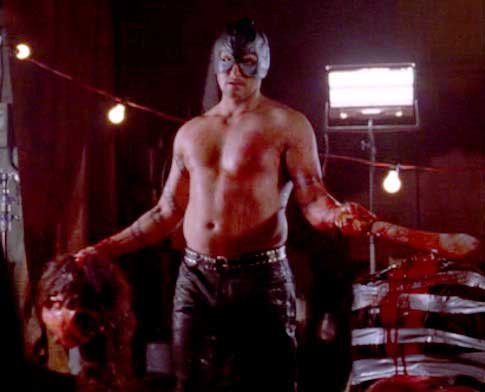 The story reminded me a bit of Tim Lucas's novel Throat Sprockets, another tale of film-related obsession. Lucas himself has spoken of the similarity on his Video Watchblog, though not disparagingly I hasten to add. It's a case of two stories being cut from similar cloth, and no one is ripping anyone off here.
A second season is on the way from Showtime. Stuart Gordon's Dreams in the Witch House has also been released on DVD with the remainder of the first season to follow. A first-rate premiere from a series that seems to be going places.
Subscribe to:
Posts (Atom)